Approach
The first step is to determine if your company has a problem. A diagnostic analysis is required to determine your firm's average manager spans of control and the number of layers for the entire firm and for each division, function and region. This is often addressed with software tools.
Let's assume we have evaluated the organization and we find that it is over-managed (i.e., there are too many managers) and there are redundant managers. Fine, but what do you do about it? Can software redesign the organization for us too? Unfortunately not, it requires old-fashioned hard work to restore the organization to fitness. How much work you need to do depends on the extent of the problem. If the problem is contained in one division, function or region, then you can focus on that one area alone. However, if the problem is pervasive, then you will need to consider the entire organization.
Spans and layers optimization is a top-down process. If you are addressing the entire company, then the process begins with the company's CEO. There are several reasons why we start at the top, but the most important is that each manager (with the help of a company's Reengineering Team or consultants) must redesign the layer below him or her. Starting at the top makes a lot of sense. We'll make these concepts more concrete through an example.
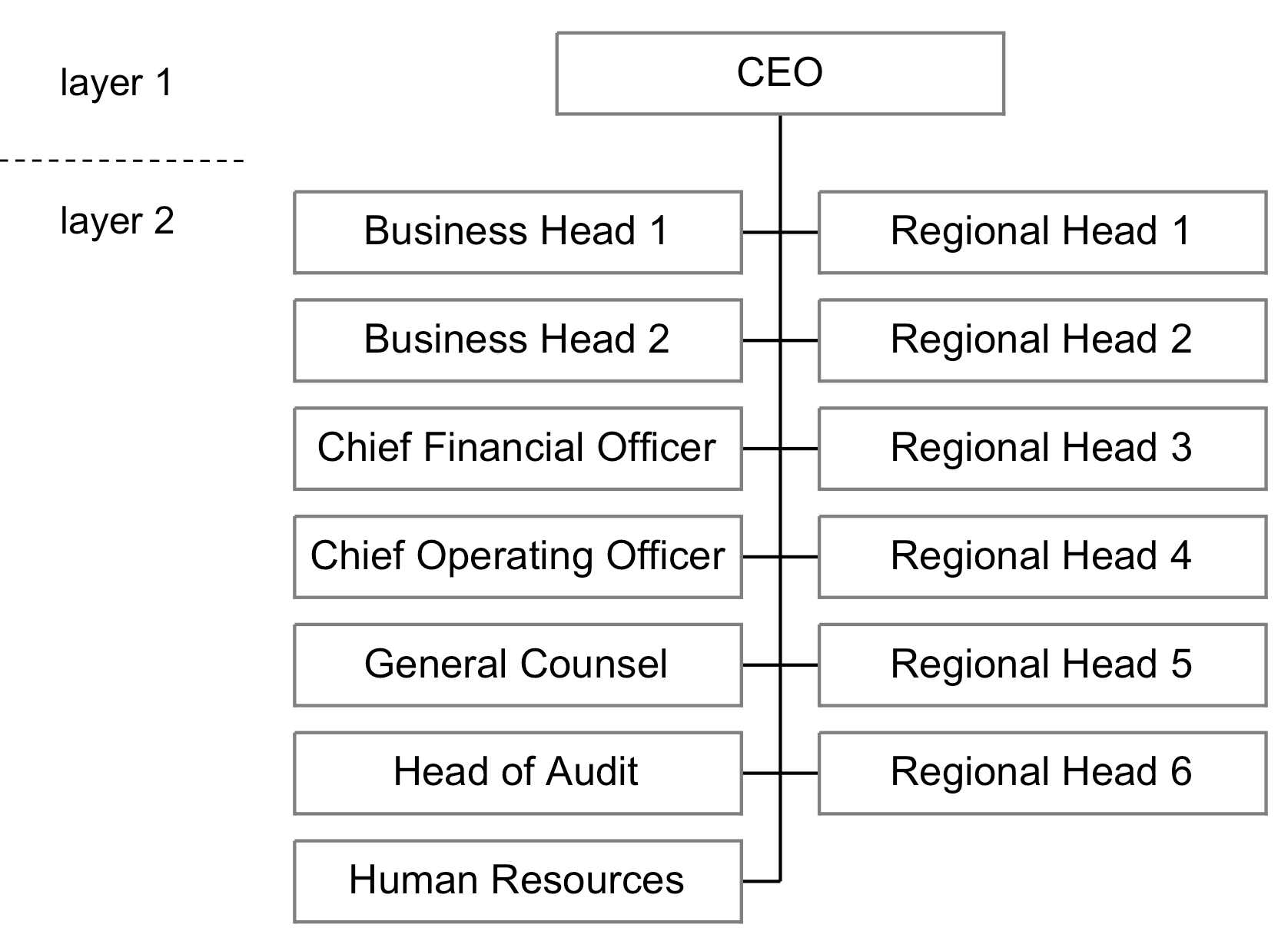
For our hypothetical company, the CEO resides on layer 1 and his or her direct reports on layer 2. These two layers are special cases, for several reasons. To begin with, layer 1 has only one employee (the CEO), so redesign possibilities are limited. CEOs generally have high spans of control and therefore there isn't much work to be done on layer 2. Given its importance to the company, layer 2 typically has already been designed carefully and reviewed periodically. The real work usually begins on layer 3.
The figure below shows the organization chart for Business Head 1 on layer 2 and his direct reports on layer 3. Of course we would have to follow the same process for all the other managers on layer 2, but we will focus on a single manager (Business Head 1) for discussion purposes. We have also shown the direct reports on layer 4, although we have excluded their titles for simplicity.
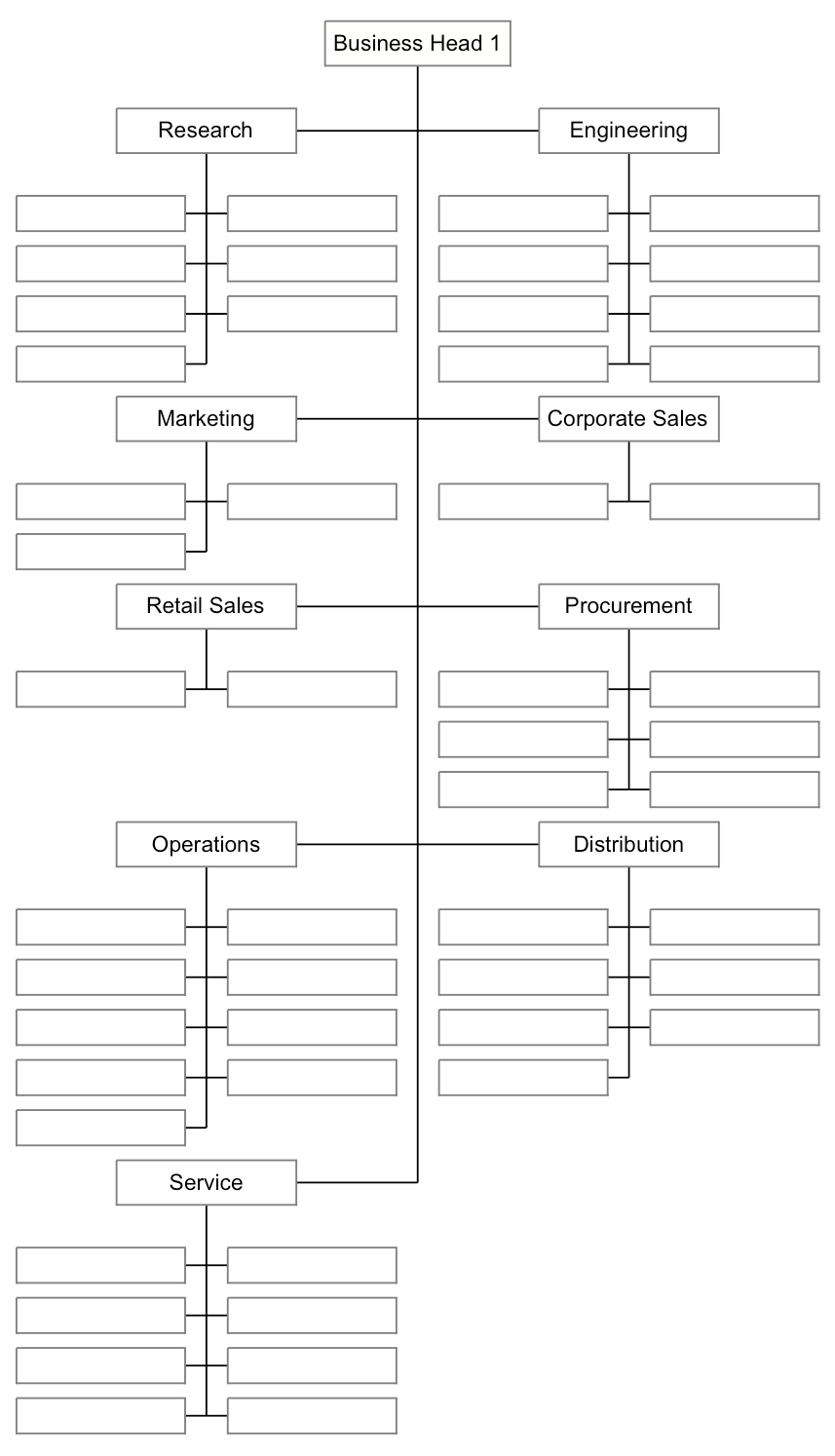
Business Head 1 is responsible for redesigning the layer that reports to him. He needs to have detailed knowledge of the responsibilities of his managers and may have to make some difficult decisions about who stays and who goes. However, he is not responsible for conducting the redesign process itself, which in itself is a full-time job. A company reengineering team, possibly a special task force, or a consulting company, should manage the process.
As you think about who will be in charge of your company's redesign process, there are a few considerations to keep in mind. Ideally you should choose a team that has this process as part of its mandate. That way the team will develop expertise in the process and will be able to run the process periodically, and will not have to reinvent the wheel each time.
The team running the redesign process (let's assume it is the company's Reengineering Team) will need to guide Business Head 1 in the redesign of his organization, but also look across other groups on layer 3 to see if there are any synergies across the company.
The first step when approaching a new layer is to remove the names of the current managers from consideration. They should be moved to a "parking lot" for later consideration. We want Business Head 1 to make decisions about managerial positions without being influenced by the current incumbents.
The second step is to compare the span of control of the managers on layer 3 with the target for this company, as shown in the table below. The target is based on data about the industry, geographic footprint, and complexity of operations. For our hypothetical company, the target is eight. This is an average for the entire company, and does not necessarily apply to each manager: some managers may have higher spans than eight, some lower, but on average we expect the company to have a span of control of eight, i.e., eight direct reports for each manager.
| Group | Span | Target | Delta | Issue? |
|---|---|---|---|---|
| Research | 7 | 8 | -1 | |
| Engineering | 8 | 8 | 0 | |
| Marketing | 3 | 8 | -5 | Yes |
| Corporate Sales | 2 | 8 | -6 | Yes |
| Retail Sales | 2 | 8 | -6 | Yes |
| Procurement | 6 | 8 | -2 | Maybe |
| Operations | 9 | 8 | 1 | |
| Distribution | 7 | 8 | -1 | |
| Service | 8 | 8 | 0 |
At first glance, the Research, Engineering, Operations, Distribution and Service managers look fine from a span of control perspective. The Procurement manager is a borderline case. The Marketing and the two Sales managers clearly have issues that need to be addressed. We will review all of the managers, in order of their delta from the target span. Why are there two Sales managers, both with very low spans of control? It seems intuitively obvious that these two groups should be merged together and managed by one person. Situations similar to this arise frequently for logical reasons, such as the following:
A Sales management role was created to accommodate a valuable or loyal manager who has no other position.
The two Sales groups may have been much larger at one time and required two managers, but when the groups were downsized the managers were not.
Possibly one manager will be replacing the other in time, and this structure allows the company to test the new manager before he/she takes over.
The two managers may do a lot of sales themselves and don't have time to manage more staff members.
This twin-manager structure may be appropriate, based on the specific circumstances. However, a situation with a span of control significantly below the target span needs to be examined carefully through a role redesign process to determine if it is a case of 'over-management' (i.e., too many managers).
The role redesign process may vary for different firms. However, there is a basic set of principles to be followed in any redesign process. The first principle of redesign has already been applied: separate the role from the individual. If the second Sales manager position was created merely to accommodate an employee without a position in the firm, then it will become apparent when the individual's name is removed from the position.
The second principle is to separate the past from the present. While it may be informative to know why we have reached this particular twin-manager structure, it should not cloud our judgment regarding what is the appropriate structure for the present and the future.
The third principle is that the responsibilities of the manager should be specified explicitly. Usually these duties are described in the manager's job description. The fourth principle is a corollary of the third: managers should not have individual contributor activities as part of their formal job description. Periodically all of us have to do things to help a customer or our teams that are not part of our job description, which is fine and normal, but it shouldn't regularly consume a significant amount of a manager's time. If a manager is expected to regularly handle such tasks, then it should be built into his or her position description, or, better yet, it should be reassigned to his or her subordinates. Let's make this tangible by looking at our case study.
The two Sales managers' job descriptions explicitly state that their roles are to manage their sales forces: hiring, training, setting goals, reviewing progress, and evaluating and rewarding performance. However, in addition, the managers periodically get involved in specific transactions to help 'close the deal'. Given their effectiveness, the managers spend so much time on transactions that they don't have time to fulfill their specified managerial duties. This results in two super salespeople, but their teams languish because they are not being trained, they are not receiving feedback, they are not being forced to fail or succeed, and, when they leave the company, they are not being replaced – all because the two managers are serving as sales people and not as sales managers. In this case it is important to exclude sales activities from the managers' role descriptions. In the redesign of their roles we would reiterate that they are to build and run a sales force and not to contribute to the daily sales process.
Business Head 1 has to determine whether one manager can manage the Corporate and Retail markets, if the manager is no longer involved in transactions. In this case, he recognizes that the two sales managers were getting rewarded for their roles in closing transactions, instead of the overall results of their teams. He reviews the formal duties of a Sales manager and decides that the Retail and Corporate Sales should report to a single manager. When the two groups are merged, the Sales manager has a span of control of 4.
Business Head 1 has made progress in span of control optimization of the Sales group, and he may have more work to do. However, now the Marketing group has become a bigger issue, so he turns his attention there. This particular company has a Corporate Marketing group that reports to the Chief Operating Officer and was designed to provide centralized marketing support for all businesses. So why does Business Head 1 have a small Marketing team? Because his predecessor felt that the central Corporate Marketing group was not providing everything the business needed, and so he created his own Marketing team, which is a violation of our fifth principle.
The fifth principle is to forbid shadow organizations. Or, in other words, do not allow a manager to do work that is the responsibility of another group. If a service group is not satisfying the needs of the company, then fix the service group. Do not create fixes all over the firm: not only is this inefficient, but it adds new problems, such as coordination between the Marketing groups, mandate confusion, and other complexities.
This particular Marketing group is serving two functions: providing some of the support that should come from Corporate Marketing and, second, placing advertisements, which is not within Corporate Marketing's mandate. This advertising activity is linked closely to the Sales group. To apply the fifth principle, Business Head 1 moves the advertising activity under the Sales manager, creates a stronger service level agreement with the Corporate Marketing group, and eliminates the Marketing manager reporting to him. His redesigned group is shown below.
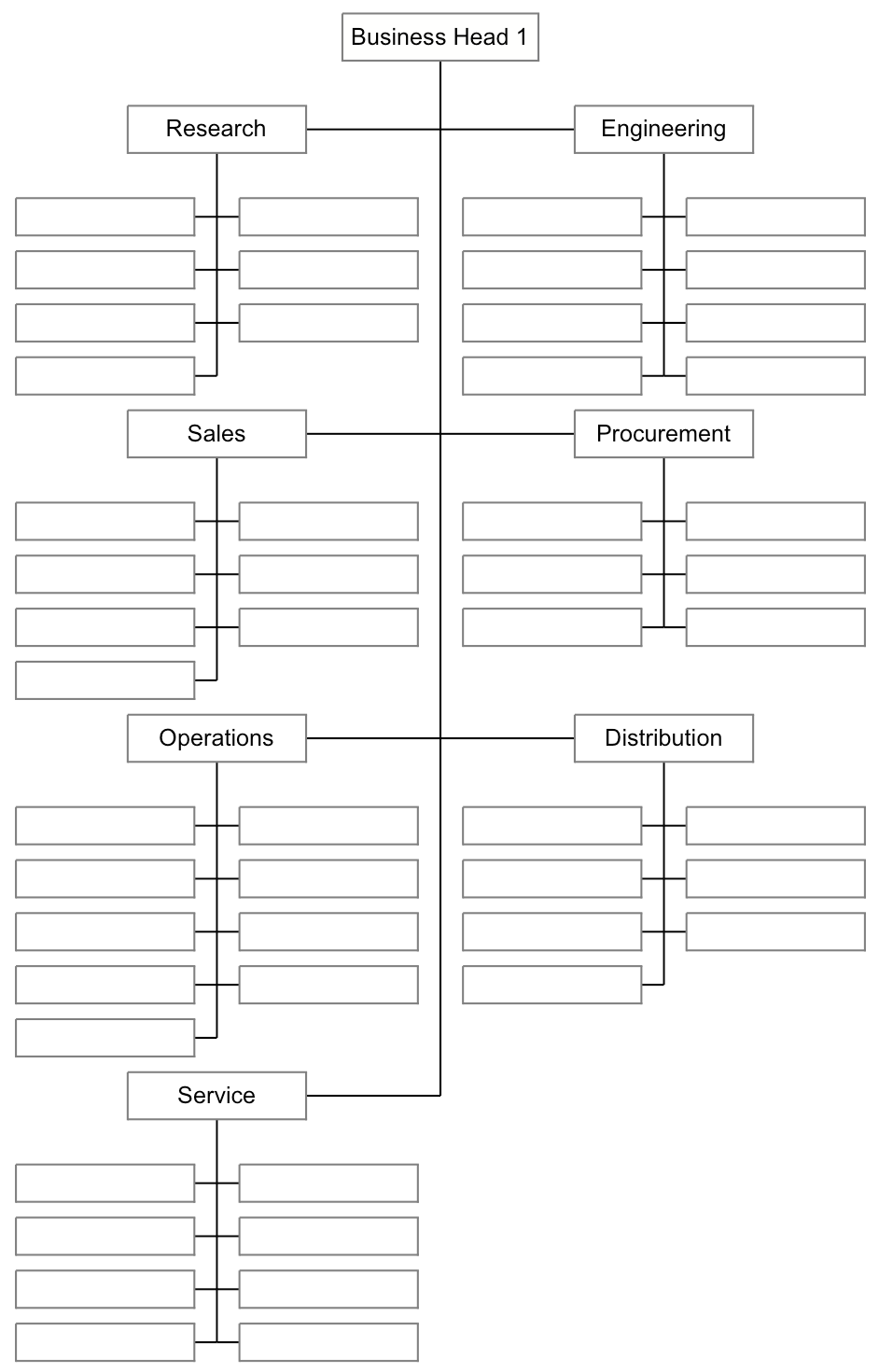
Now that Business Head 1 has settled on a group structure, the next step is to put manager names back onto the organization chart. The goal is to put the best manager into each open position. The managers of Research, Engineering, Procurement, Operations, Distribution and Service will likely return as the leaders of their groups. However, three names will remain in the "parking lot," that of the two Sales managers and the Marketing Head, but there is only one position available, the Sales position. Business Head 1 has to choose the best candidate, and the other two will remain in the parking lot, available for open positions in other parts of the firm, or for positions outside of the firm. Business Head 1 may have more work to do, but for the present time the work on his organization's structure is sufficient. The Reengineering team should look at the efforts by other groups and see if there are any potential synergies with this group.
While Business Head 1 is busy redesigning his group, the other managers on layer 2 are going through a similar exercise. Business Head 2 has a similarly structured group. However, she has encountered a different issue. The diagram below shows her organization, after the names of direct reports have been removed.
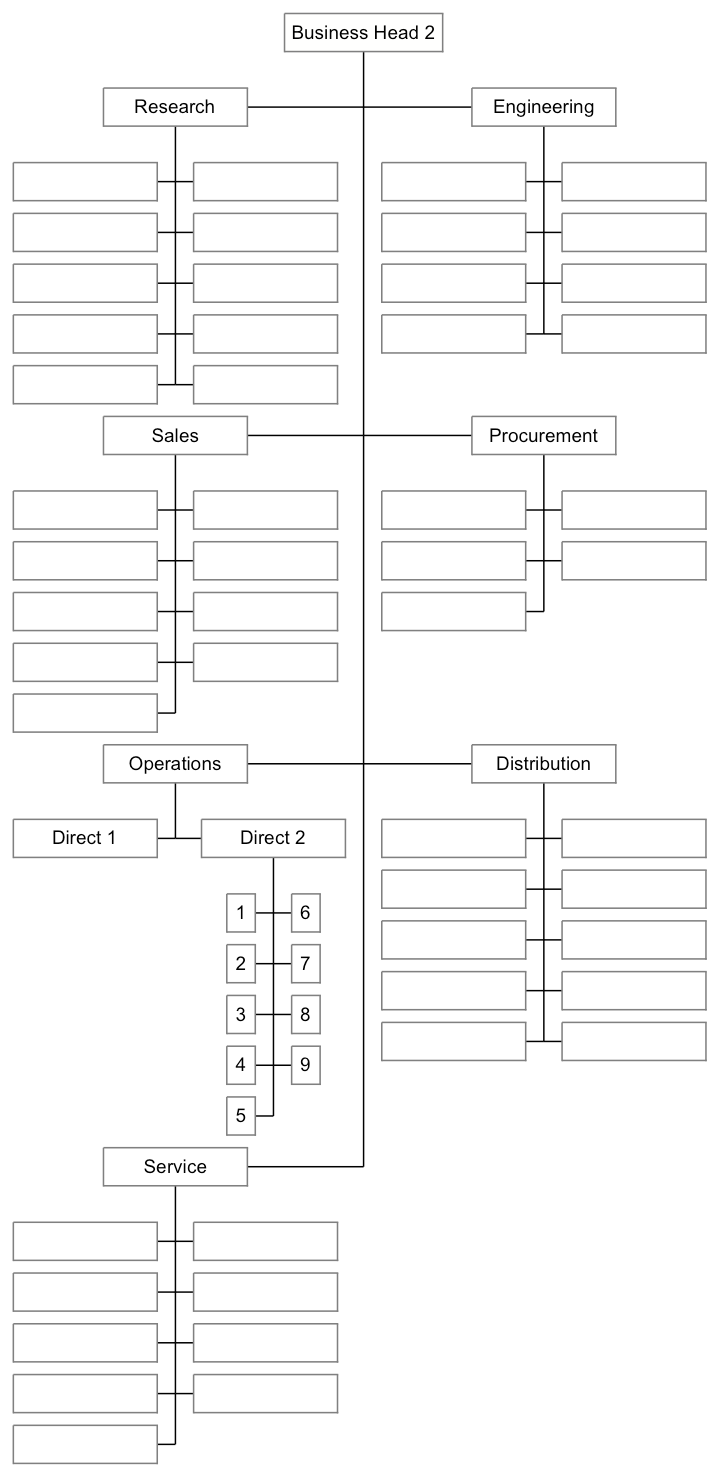
We have shown layers 2 through 4; for Operations we have also shown layer 5. Focusing on Operations, we can see that there are two direct reports on layer 4. However, one of those direct reports has nine direct reports on layer 5 (the small boxes). This structure may be the result of several different causes. In this case, Direct 2 has risen up through the ranks and is effectively managing Operations. Direct 2 could move up to layer 3, but there is nowhere in the organization for the current Operations manager to go. The Operations manager on layer 3 is truly a redundant employee. This leads to our sixth principle: a low-span manager with a high-span direct report is likely redundant. In this case, Direct 2 and the Operations manager roles are combined, which reduces a management layer. It is likely that when Business Head 2 moves the names from the parking lot back into her group chart that the former Operations manager will no longer be considered the best choice for this role.
Now that managers on layer 2 have redesigned layer 3, and chosen the managers to fill those positions, it is now time for them to instruct those managers to redesign layer 4. At this point we can see another advantage of starting the redesign process with the CEO and cascading down the layers of the organization; if the CEO and the CEO's direct reports have participated in the process, then they will be committed to the process and will convey that commitment to managers below them and throughout the organization.