Introduction
Without disciplined efforts to stay fit, firms often grow to be bloated, bureaucratic and inefficient. Reducing layers of management and increasing manager spans of control is a time-tested method for improving a firm's fitness.
Let's begin with an example to define a few terms. The tiny company shown below has eleven employees: five are managers and six are independent contributors. Managers have direct reports, and independent contributors do not.
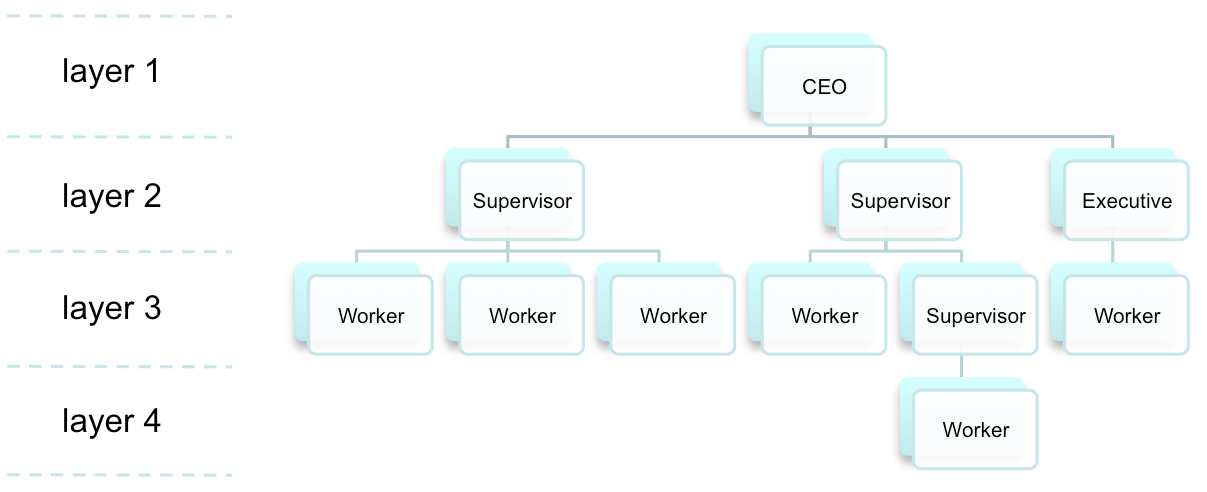
There are four layers in this organization, from the CEO on layer 1, to the Worker on layer 4. Layers are defined by reporting relationships. The CEO and one Supervisor have a span of control of three (i.e., each has three direct reports). The second Supervisor has a span of control of two. The Executive and the third Supervisor have a span of control of one. Independent contributors (i.e., Workers) do not have a span of control because they lack direct reports.
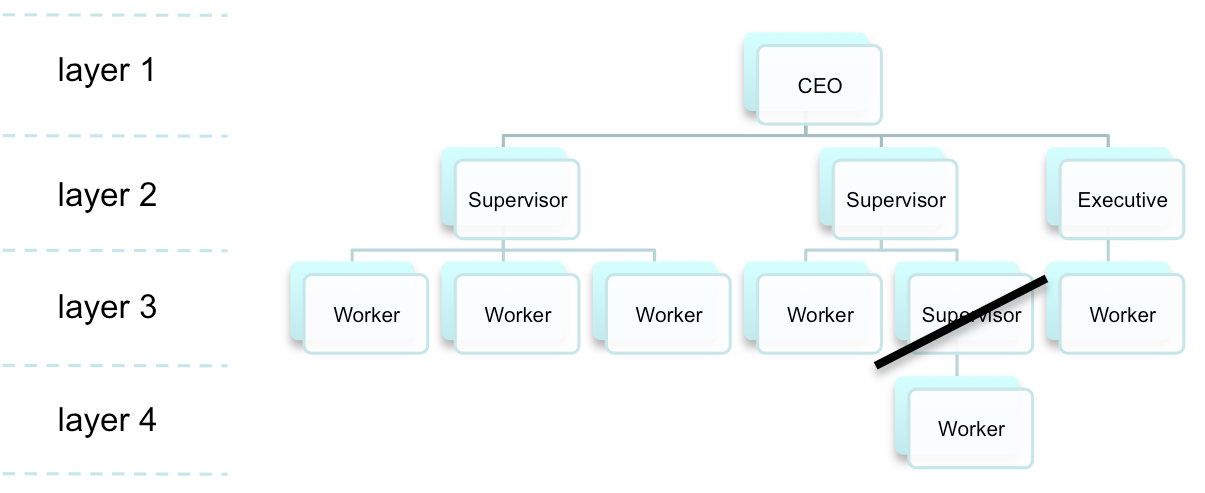
This organization can benefit from layer and span optimization. Layer optimization is a process of reassigning or eliminating managers who create unnecessary layers. Below we have identified a Supervisor overseeing one Worker. This Supervisor is a candidate for optimization because he has a low span of control, as does his manager. Layer optimization would identify him as a candidate for elimination from this part of the organization. Let's assume this Supervisor is redundant and is removed.
The organization now has three layers.
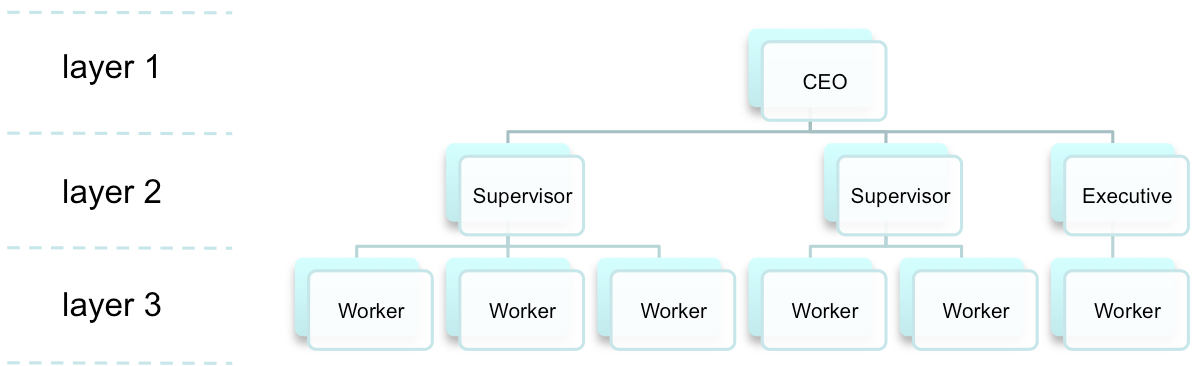
Span of control optimization is the process of reassigning or eliminating managers with suboptimal spans of control. The CEO and one Supervisor have a span of control of three, the other Supervisor has a span of two, and the Executive has a span of one.
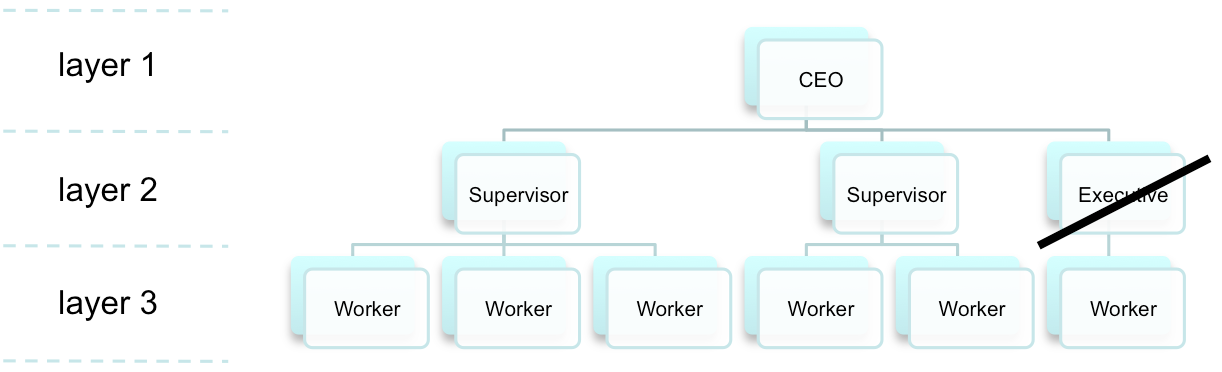
If a typical manager can oversee three direct reports, then there is an opportunity to combine workers under either the Supervisor or the Executive. In this case we have eliminated the Executive, yielding the final optimized organization shown below.
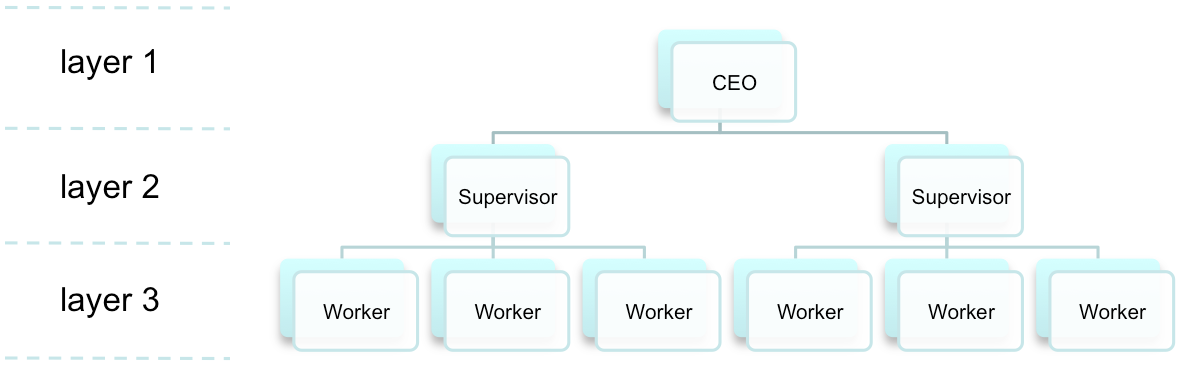
By eliminating two managers, we have reduced management by 40% and have increased the average span of control by a similar degree. Of course, layer and span optimization are easy for this simple example. In reality, for large organizations the process is much more onerous and requires a systematic process and software.
For a given number of employees, a higher average span of control implies a lower number of management layers. The appropriate span of control for a firm depends on several factors, including its industry, the type of work it performs and its geographic reach. There are some established rules of thumb for different types of firms. Also, benchmarking against similar firms may help you understand if your firm has an appropriate span and layer structure.
Organizations that successfully flatten and widen their management hierarchies don't just save money; case studies have shown that these organizations also have improved decision making, enhanced accountability, faster and more reliable communication, are more efficient, and their employees are happier.
If lean, flat organizations are superior, then why do companies' organizations become bloated? The same reason that sedentary humans recognize the benefits of fitness, but grow out of shape; weight gain and body shape changes are slow and insidious. If an organization does not periodically check its fitness, then it too will gradually get out of shape. Often an organization doesn't realize it has too many management layers or a span of control problem until its cost structure becomes out of line with industry benchmarks. After a company works itself into a fit condition, it needs to periodically check its spans and layers to ensure that it remains fit.
Like any person trying to get fit, starting the process can be the hardest part. Furthermore, if the goal of the project is to reduce expenses, then the last thing you want to do is to hire expensive management consultants to solve your problem. This Handbook is designed specifically for firms in this situation.